

By Gareth Baines, PARTNER RISK Solutions
The insurance market has shifted materially in recent years, and from where I sit, the way risks are presented has not always kept pace.
Loss events that were once contained to a single site now regularly affect multiple assets, locations and entire portfolios simultaneously. That shift has changed what we look for, and it has changed what brokers need to bring to the table when placing commercial risks.
The focus can no longer rest solely on the construction quality of a building or the protections installed within it. The first question in any credible underwriting assessment is more fundamental.
Where is the risk located, and what does the environment around it look like?
At PARTNER RISK Solutions, we do not treat location as a formality on a proposal. In many cases, it is the first real indicator of whether a risk is viable. Before any internal characteristic of an asset is considered, the external environment is evaluated to establish whether that risk can be sustainably supported.
Accumulation: When Individual Risks Become Concentrated Exposure
One of the least visible, yet most consequential, underwriting considerations is risk accumulation. It is also one of the most misunderstood, and in my experience, it is the factor that produces the most frustration when a seemingly low-risk fails to place cleanly.
From a broker’s perspective, a client may present as a well-managed, low-risk operation with strong protective measures and a clean loss history. That presentation may be entirely accurate.
The problem is that underwriting decisions are not made in isolation. Each risk forms part of a broader portfolio, and portfolio exposure is managed at the geographic level.
Where multiple insured assets are concentrated within the same area, exposure to a single event increases substantially. A severe storm, a substation failure or a fire originating from an industrial site can trigger losses across several insured locations at the same time. This is where accumulation becomes decisive.
Insurers monitor their total value at risk within defined geographic zones. When exposure in a particular area approaches internal thresholds, additional placements in that zone may be restricted, repriced or declined. This is not about the individual risk. It is a reflection of the cumulative exposure already carried within that location.
For insurance brokers, this explains a situation that can feel genuinely counterintuitive: a technically sound risk encountering resistance in the market despite a strong presentation. The constraint does not lie within the client’s operations. It lies in the density of insured exposure already concentrated in the surrounding area.
At PARTNER RISK Solutions, we use geospatial tools to map and monitor that exposure. That helps us deploy insurance capacity more carefully across the portfolio.
Infrastructure as an Active Risk Variable
A building’s internal protections are only as effective as the infrastructure supporting them. In the South African context, this is not a theoretical concern. It is a practical reality that shapes underwriting assessments on a regular basis.
Municipal performance, service delivery reliability and infrastructure maintenance all influence how a risk behaves when a loss occurs. The gap between what exists on a proposal form and what operates in practice can be considerable.
Consider a warehouse fitted with a fully compliant sprinkler suppression system. On paper, the risk appears well-protected. In practice, the effectiveness of that system depends entirely on consistent water pressure and supply. Where municipal infrastructure is under strain, pressure may fall below the threshold required for suppression systems to function as designed.
In those circumstances, the presence of a sprinkler system does not equate to effective fire protection. The system is there. The conditions for it to work may not be.
The same applies to emergency response. Road conditions, congestion and local resource constraints can materially affect response times. A delay of a few minutes in the early stages of a fire changes the loss outcome. That is not conjecture. It is documented in loss histories across the region.
Power instability adds further exposure. Extended outages may compromise security systems, disrupt operational continuity or affect temperature-controlled environments, increasing both the likelihood and severity of claims.
In practice, this means that two structurally identical buildings can present very different risk profiles depending on where they are located. The asset may be the same. The operating environment is not.
That is why infrastructure quality matters in our assessment of location. A stable municipality is easier to underwrite than one where core services are unreliable. That is simply the reality.
The Exposure That Starts Beyond Your Boundary
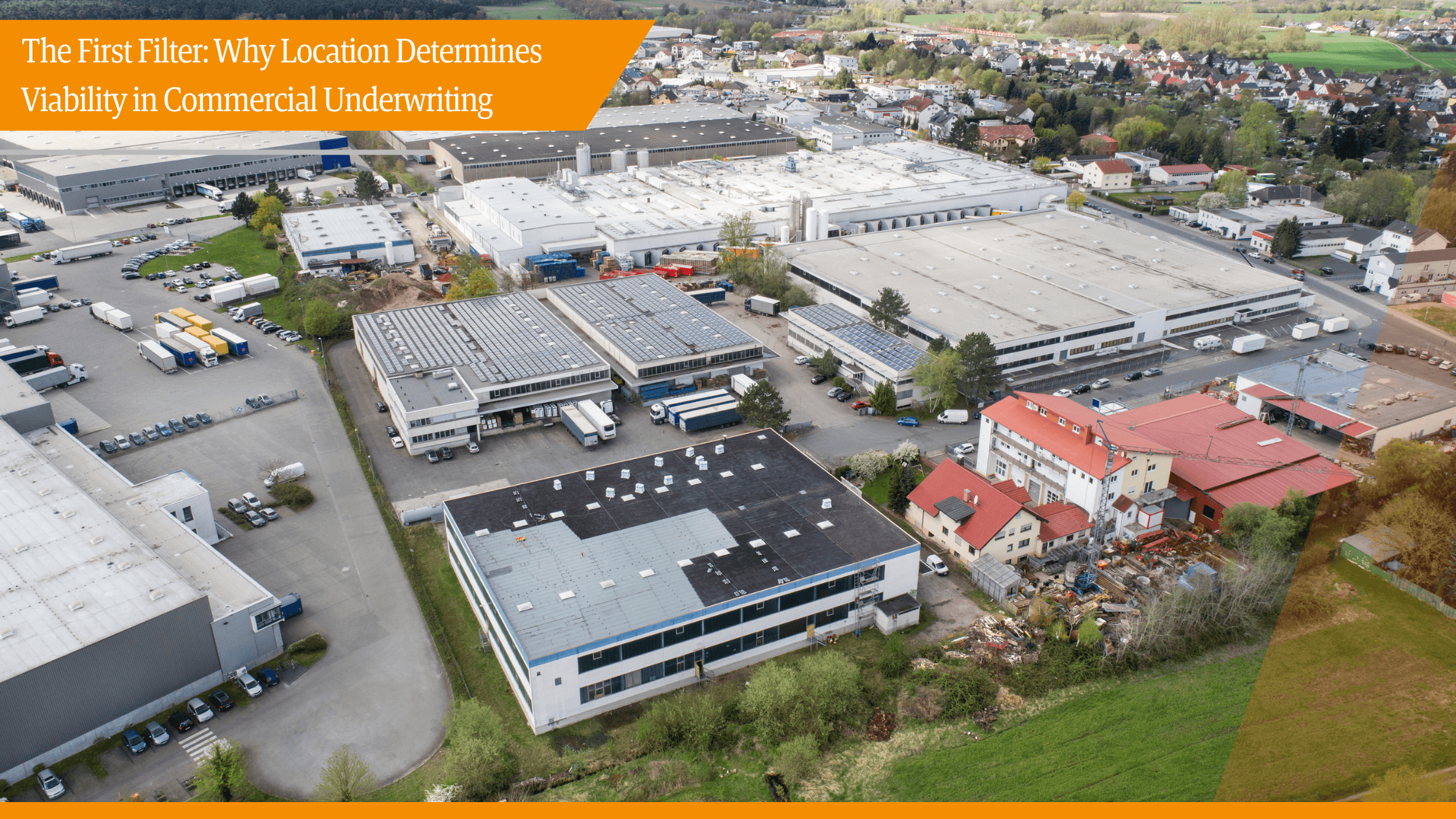
No property can be underwritten in isolation. Proposal forms focus on the insured’s own operations, which is understandable, but a meaningful portion of the risk may originate from neighbouring premises. These exposures are often invisible on paper and consequential in practice.
A low-hazard operation may be situated immediately adjacent to a facility that presents a higher risk: a recycling depot, a timber processing yard or a chemical storage facility. In the event of a fire or explosion originating from a neighbouring property, the insured can sustain serious damage despite maintaining strong internal controls.
This is the nature of adjacency risk. It does not respect property boundaries.
From an underwriting perspective, the surrounding environment is assessed alongside the insured asset. Satellite imagery, site surveys and risk inspections are used to identify nearby hazards that could influence the overall exposure profile. What sits next door matters.
For insurance brokers, this reinforces the value of understanding not only the client’s own operations, but the immediate environment in which those operations take place. A comprehensive risk presentation extends beyond the perimeter fence.
Two Warehouses, Two Outcomes
I find this scenario useful when explaining locational underwriting to brokers who are encountering market resistance they do not expect.
Take two warehouse risks that are identical in every internal respect: same construction, same suppression systems, same security, same management.
Warehouse A is situated on elevated ground within a well-maintained industrial zone. Municipal infrastructure is stable. Water supply is consistent, emergency response times are reliable, and surrounding properties present a low hazard profile. Accumulation within the area remains within acceptable limits.
Warehouse B is located in a flood-prone area on the periphery of an industrial region. Municipal services are inconsistent, with documented issues relating to water pressure and road access. Adjacent properties include higher-hazard operations, and the insurer already carries significant exposure in the surrounding zone.
Same building. Fundamentally different risk.
Warehouse A may attract stable terms, competitive pricing and broad insurer appetite. Warehouse B may face increased rates, restricted coverage or limited capacity, and none of that reflects poorly on the insured or their operations. It reflects the location.
For brokers, the implication is clear. Presenting a risk well means presenting the location well. Clients benefit from understanding this early, before they reach the market.
Aggregation and the 72-Hour Clause
Location-driven perils frequently trigger the 72-hour clause within property insurance policies.
Where multiple losses arise from the same event within a defined period, typically 72 hours, they are treated as a single occurrence for the purposes of deductible application and policy response. In the context of storms, floods or other widespread events, multiple affected assets within the same geographic area may be aggregated into one loss event.
This reinforces the significance of accumulation management at the portfolio level. A single weather event can produce multiple claims, all falling under one deductible and one policy limit. The geographic concentration of insured assets determines how large that exposure becomes.
Understanding the 72-hour clause is not purely technical. It has direct implications for how location-based concentration is managed, and for how brokers should counsel clients on the relationship between geographic clustering and claims outcomes.
Location as the Foundation of Sustainable Underwriting
Location is the first filter. In commercial property underwriting, it shapes market appetite, pricing and capacity before most other factors are considered.
For insurance brokers, that means approaching risk presentation with a broader frame. The quality of the asset matters. So does the infrastructure around it, the hazard profile of neighbouring properties, and the accumulation position of the insurer being approached. These are not peripheral concerns. They are central to how placement outcomes are determined.
At PARTNER RISK Solutions, locational assessment is embedded in the underwriting process from the outset. Where questions arise around a particular location, the objective is to ensure that the risk can be supported sustainably and that the terms reflect the actual exposure being carried.
A well-structured risk is not defined only by what is inside the property. It is defined by everything surrounding it, and whether that environment supports a loss outcome that can be contained.